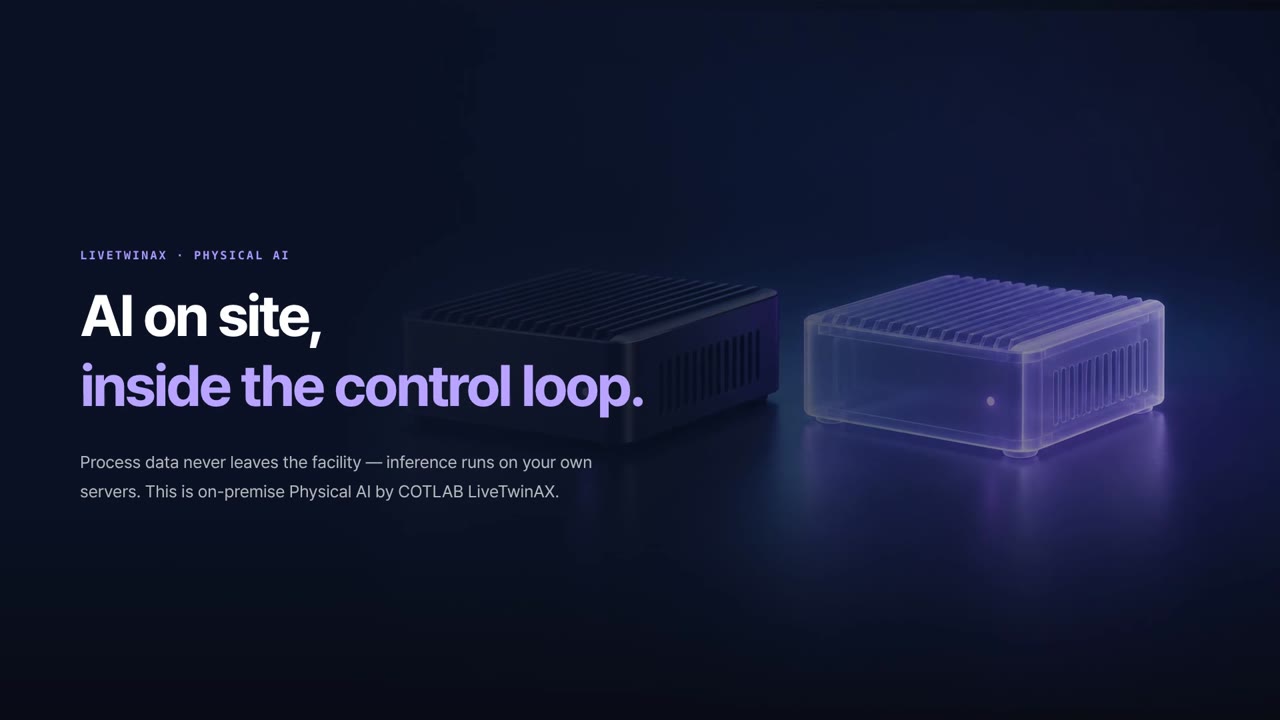
LiveTwinAX Official Overview | AI-Integrated Control Platform for Smart Factories, built on EPICS
Length 14:21 · Published November 9, 2026 · Language English
LiveTwinAX keeps your existing PLCs and equipment and brings collection, decisions, control and the 3D twin into one platform on EPICS. AI outputs numbers and the EPICS DB makes the decisions. Decisions that reduce output apply automatically; decisions that change the process go through operator approval before the sequencer applies them.
All five processes in this film (EV battery formation, gear gas nitriding, gallium oxide single crystal, offshore wind, KEPCO distribution) run on the real LiveTwinAX screens with twin simulation data.
Chapters
- 0:00Intro
- 0:11Why a real-time operating base
- 0:57Platform
- 2:07Physical AI principle
- 2:48CASE 1 EV battery module formation
- 4:36CASE 2 Gear gas nitriding
- 5:49CASE 3 Gallium oxide single crystal
- 7:02CASE 4 Offshore wind 60 MW
- 8:30CASE 5 KEPCO 22.9 kV distribution
- 10:01Five processes in summary
- 10:15Expert know-how · standards · security · retraining
- 11:39Applying it across MAPS
- 12:53Same platform, different scale
- 13:08Cotlab
- 13:27Adoption roadmap
- 13:47Conclusion
Related pages
Transcript
Full narration of the film. Select a chapter to play from that scene.
0:00Intro
LiveTwinAX is the AI-integrated control platform for smart factories. On EPICS, the proven control standard, it becomes the real-time operating base for MAPS sites.
0:11Why a real-time operating base
Mobility, AI data centers, Physical AI, and smart factories. Cotlab calls these four industries MAPS. They share one thing. AI now moves real equipment: batteries and parts, cooling and power, robots and factories. So these sites need a real-time operating base that reads state, decides, and controls within its authority. Collecting data and running equipment are different skills. Operation must keep timing, sequence, fault recovery, and command authority. EPICS is the open-source control standard that has run nonstop facilities, like accelerators and fusion, for over 30 years. ITER integrates about a million signals with EPICS. As factories and data centers grow, it scales with no vendor lock-in or tag fees.
0:57Platform
As an AI-integrated control platform for smart factories, LiveTwinAX keeps your existing PLCs and equipment. It ties Mitsubishi, Siemens, OPC UA, and Modbus signals into one set of EPICS process variables. The EPICS DB on the controller makes decisions and interlocks; Process Logic runs physics models and AI. Screens, the 3D twin, and the recipe sequencer share the same process variables, so you control from the screen you watch. Field engineers build it themselves, with no coding. Drag and drop screens, symbols, and 3D twins, then draw PLC I/O, EPICS DB, physics and AI blocks, state machines, and wiring diagrams in one project. A proven project becomes a template, reused as-is on the next process. Operation and analysis share one workspace. Screens, 3D twin, trends, alarms, single-line diagrams, and GIS maps all read the same process variables. Every moment is recorded, so you can replay the exact screens and turn them into reports. An on-site AI assistant helps with the work.
2:07Physical AI principle
When AI moves equipment, one rule applies. AI only outputs numbers, and the EPICS DB makes the decisions. Safe-side actions, like reducing current, apply automatically; process changes like temperature or time go through operator approval and the sequencer. If AI stops or its confidence drops, it falls back to conservative defaults, and safety interlocks stay in place. Now we run five MAPS-related processes live in LiveTwinAX. Mobility batteries and gears, a next-generation power semiconductor material, and generation and distribution built like data center power. Every action uses the same screens and buttons operators use.
2:48CASE 1 EV battery module formation
First, EV battery module formation, the core of mobility. When one cell runs hot, a bad weld means slow down, and an internal short means stop now. Conventional interlocks can't tell them apart, but LiveTwinAX finds the cause from the same measurements. Open the project, start the IOC, then run the physics and AI blocks. Normal formation: constant current 99 A, cell-to-cell spread 0.24 K. We inject a busbar weld defect in cell 15. Contact resistance times four. AI splits the excess heat into a current-proportional part and an unrelated part. It's contact resistance. So it slows down: the DB cuts the current limit to 52 A, keeping the spread under the interlock limit. For comparison, revoke AI diagnosis — and it's conventional interlocking. In 10 seconds the interlock trips and charging stops. It re-enables when cool, then trips again. Restore the authority, and it slows down again and keeps forming. The 3D twin subscribes to the same process variables. Cell 15 shows hotter than its neighbors. This time, we inject an internal micro-short into cell 9. When current-independent heat exceeds the limit, the DB latches the short and stops charging. Same symptom, one hot cell, opposite answers: slow down for contact resistance, stop for an internal short. With AI diagnosis, interlock trips fell from six to zero, and the shorted cell stopped instantly. AI's authority goes one way. It can only lower current or stop, and raising current belongs to the recipe. In EV battery and ESS cell processes, it cuts unnecessary stops and halts only the dangerous cells.
4:36CASE 2 Gear gas nitriding
Second, gas nitriding of gears, which sets drivetrain part life. Case depth needs a destructive test, and results take days. Recipes end on time, so if conditions drift, defects form without any alarm. The 3D twin shows the retort's gear load and heaters from the same variables. Two-stage nitriding. AI predicts the final depth under current conditions. It exceeds the target, so no recommendation. Then the ammonia dissociation behavior changes. Even with the PID fully open, nitriding potential drops below the boundary. Still, no alarm sounds. When the forecast dips below target, the DB recommends extending stage two by 1.9 hours. Because it changes the process, the operator approves it, and the recipe sequencer delays the end of stage two, within limits. The extended stage two ends, and case depth reaches the target. A time-based batch would have fallen short; this one reached target depth. AI looks ahead, the DB recommends, a person approves, and the sequencer applies. For electrical and drivetrain heat treatment, it's how to hit quality during the process, without waiting for destructive tests.
5:49CASE 3 Gallium oxide single crystal
Third, gallium oxide single-crystal growth, a next-generation power semiconductor material. Inside an opaque iridium crucible, a concave solid-liquid interface leads to polycrystals. LiveTwinAX estimates the interface shape from signals outside the crucible, and changes setpoints only after operator approval. AI estimates the interface shape from just six signals outside the crucible. The disk in the 3D twin is the solid-liquid interface; color shows its convexity margin. We inject a slow decline in pedestal heat removal. Control thermocouples and RF power stay unchanged. Conventional screens show nothing. AI sees concave risk, and the DB recommends a setpoint of minus 25 K. The operator approves, and the sequencer lowers the setpoint. The interface returns to convex. With the same defect, concave time fell from 6.1 hours to 2.5. Changing setpoints always stays with the operator and sequencer. AI estimates the hidden state, and equipment moves only through approved paths. Physical AI needs this structure.
7:02CASE 4 Offshore wind 60 MW
Fourth, a 60 MW offshore wind farm. Like data center cooling and power, many units share the load. Bearing wear can't be measured, and absolute alarms come too late. So the turbine stops, and the farm misses its dispatch order. KEPCO dispatch: 45 MW. Twelve turbines each carry 75% of available output. A normal behavior model predicts the expected temperature; we watch the residual. Turbine 6's bearing losses rise to 2.5 times. The absolute alarm is far off, but the residual is already rising. As the residual persists, the DB latches derating, capping output at 2 MW. Healthy turbines pick up the difference, so farm output still meets dispatch. The 3D twin shows the same values: turbine 6 runs capped at 2 MW, the others carry 3.9 MW each. Bearing temperature settles near 70 °C, below the alarm. Cut the link, and it reverts to the conventional method, the bearing at rated load hits the 80 °C alarm. That's when the old way first notices. Run it lighter instead of stopping. The DB decides; inference only outputs numbers. Acting 23 K before the alarm, no turbine stopped, and the farm held 45 MW. It applies directly to equipment that shares load, like data center cooling pumps and chillers.
8:30CASE 5 KEPCO 22.9 kV distribution
Fifth, KEPCO's 22.9 kV distribution grid, which feeds factories and data centers. Rooftop solar sits behind the meter, invisible to substations, so feeder loads look lighter than they are. If clouds pass over a feeder carrying restored load, hidden load appears and can trigger another outage. Midday. Feeder F4 measures 4.97 MVA, but the AI-reconstructed total load is 7.36 MVA. A permanent fault hits feeder F3. The recloser tries reclosing, then locks out. With only 2.63 margin on AI total load, it can't take the full 3.38 downstream, so it restores partially. Outage sections drop from four to two. A 3D bird's-eye view over real terrain: red bands are outages, blue bands are energized. Even as clouds remove hidden generation, F4 stays at 8.83, below its 10 continuous rating. No repeat outage. Judged on measured load, as before, the margin looks ample, so everything is restored. Then clouds pass, and F4 hits 10.72, over its continuous rating. Reducing restoration applies automatically, without approval; if AI stops or leaves its training range, it falls back to installed capacity. For data center and factory grids under heavy load, it's a standard for running power with hidden load in view.
10:01Five processes in summary
In all five, AI inference joined the EPICS decision loop and moved real equipment. Reductions are automatic, changes need approval, and every decision's basis remains in EPICS process variables.
10:15Expert know-how · standards · security · retraining
Experts wait two more minutes even at 0.8 bar, to be sure residual gas from the last step is gone. LiveTwinAX records that reason as a state machine condition: confirm venting, and proceed only below 0.8 bar. Events can be replayed, and every shift runs to the same standard. The standard stays even when experts leave. Define the process once: screens, 3D, logic, AI model inputs, and alarm criteria, all in one template. Next line Mitsubishi or Siemens, just remap PLC addresses and scaling, then verify. Sites at home and abroad run to the same standard, packaged as a standard control module for smart factory solutions. Security narrows paths and permissions as connections grow. Collection, training, and inference stay on site, no external cloud. Permissions split into read, edit, approve, and execute; each process variable opens just one approved write path. Every access and action is audit-logged, and an open-source security stack responds quickly to vulnerabilities. Each fault today was first injected in the twin to verify the logic. On site, measurements, decisions, and actions are all recorded, and that data retrains the AI. The more field data builds up, the more accurate the AI becomes, and EPICS connects the whole process in real time.
11:39Applying it across MAPS
In mobility, it assures battery cell and drivetrain part quality mid-process. AI estimates hidden cell and part states, the EPICS DB decides to slow, stop, or extend, and every decision becomes quality history. One proven template sets the same standard across battery and parts lines worldwide. AI data centers can never let cooling or power stop. Run worn pumps and chillers lighter, and scope power restoration with hidden load in view. Add an EPICS operations layer to cooling and power equipment, and it becomes a data center operations solution. For Physical AI, the key is safely linking AI decisions to real equipment. AI outputs numbers, the EPICS DB decides within limits, and people approve process changes. As AI models and robots enter industry, it becomes the layer for their execution and safety. In smart factories, manufacturing know-how becomes a control standard reused across vendors and lines. Between design-and-simulation twins and field PLCs, LiveTwinAX and EPICS fill the place of real-time decision and control. Linked with MES, it becomes the real-time operations module of a smart factory solution.
12:53Same platform, different scale
The same platform maps the national grid on GIS, and visualizes signals from accelerator rings no one can enter, live. From one factory to global production sites and data center campuses, it scales with the same structure.
13:08Cotlab
Cotlab has proven this technology in control rooms of fusion, accelerator, and nuclear research facilities. Since 2023, we've partnered with Osprey DCS, founded by core EPICS architects. EPICS developers and manufacturing and AI engineers handle everything from design to on-site build.
13:27Adoption roadmap
Start with one process and one recurring problem. Keep your PLCs, and confirm the impact together with field data. Proven templates expand to other lines and sites, as standard modules linked with MES. Then we extend it to smart factories, data centers, and Physical AI, as an operating standard across all of MAPS.
13:47Conclusion
To sum up, mobility assures quality mid-process, and AI data centers run without stopping. Physical AI links decisions safely to equipment, and smart factories reuse expert standards. LiveTwinAX and EPICS, the AI-integrated control platform for smart factories, are the real-time base for MAPS. Tell us one key process and one recurring problem, and we'll propose a deployment plan. Cotlab. From real-time control to autonomous operations.
Photo and map credits
- Marta Veverica, CC BY-SA 4.0: https://commons.wikimedia.org/wiki/File:Linia_zrobotyzowana_w_AIUT.png
- Yo-Co-Man, CC BY-SA 4.0: https://commons.wikimedia.org/wiki/File:Lithium_Iron_Phosphate_LiFePO4_Cells_700_Ah_Amp_Hours_3.25_Volts_-_2.jpg
- S zillayali, CC BY 3.0: https://commons.wikimedia.org/wiki/File:Computerised_Heat_Treatment_Furnance.jpg
- Simon Fraser University Public Affairs and Media Relations, CC BY 2.0: https://commons.wikimedia.org/wiki/File:Avogadro_Crystal_(in_the_furnace)_-_SFU_PAMR.jpg
- Ionna22, CC BY-SA 4.0: https://commons.wikimedia.org/wiki/File:Block_Island_offshore_wind_farm_P6290638m.jpg
- Benlisquare, CC BY-SA 4.0: https://commons.wikimedia.org/wiki/File:Suburban_rooftop_solar_power_generation_in_Canberra,_Australia.jpg
- © OpenStreetMap contributors · Esri World Imagery · AWS Terrain Tiles